A daily read on the people, products, and capital shaping how founders and operators find each other. AI-curated, editor-vetted, delivered to your inbox.
Subscribe
Today's issue · 2026-05-13 · ai-funding
Fractile's $220M, YC's agent infra wave, and VC's 9-year low
Two threads run through today's feed: serious money still chasing AI infrastructure, and a quiet anxiety about whether the venture machine is actually working. Fractile just closed $220M to attack AI inference at the chip level, a $4B recursive AI effort is pulling in notable researchers, and YC's latest batch includes a Postgres sandbox tool purpose-built for coding agents. Meanwhile, multiple reports confirm venture deal flow has sunk to a 9-year low, which makes the concentration of capital into a handful of bets look less like confidence and more like a flight to perceived safety. The HN thread asking whether any recent YC company has scaled like Stripe or Docker is uncomfortable reading against that backdrop.
UK chip startup Fractile closed a $220M round to build silicon specifically optimized for AI inference speed, targeting the gap between model capability and real-world query latency that still makes many production deployments painfully slow. This is the same problem Groq has been attacking from a different angle, and it reflects a broader recognition that the bottleneck in deployed AI has shifted from training compute to serving cost and speed. The round size signals that investors believe inference-layer hardware is a durable wedge, not a temporary fix before software optimization catches up. For founders building on top of foundation models, cheaper and faster inference is a direct input cost reduction.
Why it matters
Inference hardware is becoming a distinct investment category. Founders who assume serving costs will automatically drop through software alone may be surprised by how much specialized silicon shapes the economics.
A new $4 billion initiative targeting recursive, self-improving AI has attracted a cohort of notable researchers, according to the New York Times, marking one of the largest capital commitments to what the field sometimes calls AGI-adjacent work. The scale separates this from academic moonshots; at $4B you are hiring aggressively, building compute clusters, and operating with a commercial timeline. This sits alongside Anthropic, OpenAI, and xAI in a tier of bets where the check sizes have simply left normal venture math behind. What makes it relevant for builders is that the talent gravity of these efforts reshapes who is available to join earlier-stage AI companies.
Why it matters
When researchers of this caliber consolidate inside a single well-funded effort, the pool of senior AI talent available to seed and Series A companies shrinks further. Hiring plans built on assumptions from two years ago need revisiting.
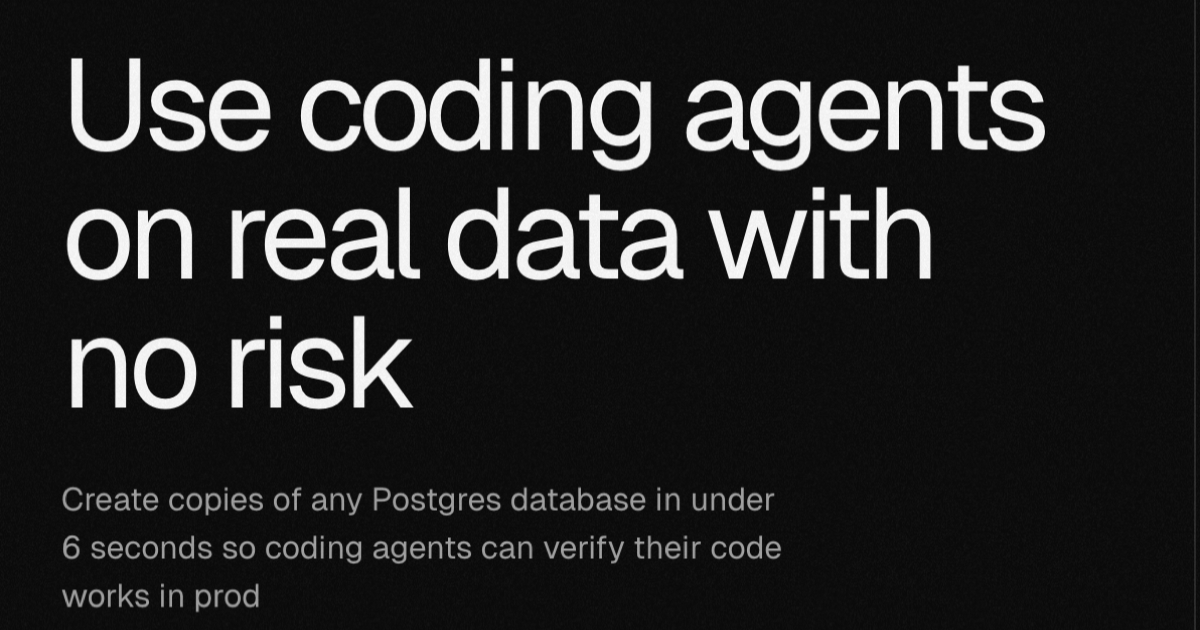
Ardent, out of YC's P26 batch, is building disposable Postgres sandbox environments that spin up in seconds without requiring migration work, explicitly targeting the workflow where a coding agent needs a realistic database to test against before shipping. The insight is pointed: agents have gotten good enough at complex engineering tasks that the weakest link is now the test environment, not the code generation itself. Ramp and Stripe both built internal versions of this kind of sandboxing, which is exactly the pattern that produces durable developer infrastructure companies. The zero-migration angle matters because the friction of standing up a realistic test DB is exactly what causes teams to skip the step entirely.
Why it matters
Coding agents need real infrastructure to test against, and that infrastructure layer is just starting to be built out as a product category. Ardent is an early signal of what agent-native tooling actually looks like.
Anthropic announced that Claude subscription plans will include a dedicated monthly credit specifically for programmatic, API-based usage, separating it from the chat interface allowance. This is a meaningful structural change because it removes the awkward situation where developers building on Claude were competing for the same token budget as their own conversational use of the product. It also signals that Anthropic is treating builders as a distinct customer segment that needs predictable, budgetable API access rather than best-effort sharing. OpenAI has used tiered API access and credits as a retention mechanism, and Anthropic appears to be closing that gap.
Why it matters
For founders prototyping on Claude, predictable programmatic credits lower the barrier to committing to Anthropic's API over OpenAI's. Watch whether the credit amounts are generous enough to matter or mostly symbolic.
A thread on Hacker News directly challenged the premise of YC's recent vintage by asking whether any company funded in the past six or seven years has broken into the top tier of outcomes, noting that YC's own top-100 list appears largely frozen at older cohorts. The timing is notable given the concurrent reports of venture deal flow hitting a 9-year low; if the flagship accelerator's recent batches haven't yet produced canonical breakouts, it raises honest questions about whether the current model scales, or whether the density of AI-native companies in recent batches just makes it too early to judge. For Philly founders weighing the YC application calculus, the thread is a useful corrective to the assumption that acceptance itself is a strong signal of outcome.
Why it matters
Prestige and outcome are drifting apart in the current environment. Founders should think carefully about what they actually get from a YC batch beyond the brand, especially as the cohort sizes have grown.
Multiple reports out today, including from The Logic and BetaKit covering the Canadian market, confirm that venture investing has fallen to its lowest deal count in nearly a decade, with the contraction concentrated at the growth stage rather than seed. This is consistent with what practitioners have been saying privately: seed is still active because check sizes are small and AI narratives remain compelling, but Series B and beyond has become genuinely difficult unless you have clear revenue metrics. For early-stage companies in markets like Philadelphia that don't have the same density of local growth-stage capital as New York or Boston, the implication is that bridge rounds and revenue-based alternatives need to be on the table earlier.
Why it matters
The funding environment that existed in 2021 to 2022 has not returned, and the growth-stage gap means companies that raise seed successfully may still face a wall 18 months later. Build your runway assumptions accordingly.
Jonathan and Thomas launched Mistle, an open-source project for running sandboxed coding agents, explicitly citing that Ramp built a tool called Inspect and Stripe built Minions internally for the same purpose. The pattern here is significant: when two companies known for engineering rigor independently solve the same infrastructure problem, the open-source version of it tends to attract serious adoption quickly. Mistle's design keeps credentials outside the sandbox and routes authorized access through a proxy, which addresses the security concern that makes most teams reluctant to hand agents real environment access. This sits alongside Ardent in a small but accelerating cluster of tools built around the assumption that agents are now a real part of the engineering workflow.
Why it matters
Agent infrastructure is being built in the open right now, and the teams that adopt these tools early will have a meaningful productivity advantage over those waiting for polished commercial products. The Ramp and Stripe precedent suggests this problem is real and universal.